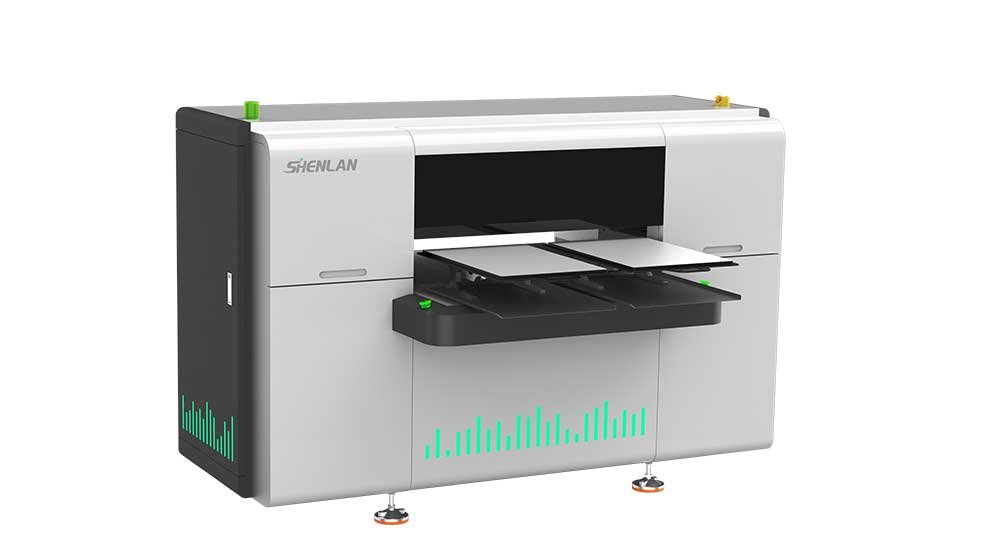
Precision Pretreatment, High-Color Printing, and Dual-Station Productivity in One Integrated System
Traditional DTG printing often requires multiple separate steps: pretreatment spraying, drying, printing, and curing. This workflow can increase labor, floor space, material consumption, and production time.
Our new 6-printhead, 8-color dual-station DTG printer is designed to simplify this process. By integrating precision pretreatment spraying and direct-to-garment printing into one workflow, it helps garment decorators improve efficiency while reducing unnecessary pretreatment consumption.
What Does “Pretreatment-Free” Really Mean?
This solution eliminates the need for a separate pretreatment spraying machine and drying station in the standard workflow.
Instead of applying pretreatment across the entire garment surface, the system uses dedicated pretreatment spray heads installed alongside the printing heads. The machine applies pretreatment only where the artwork will be printed.
1. Pretreatment Only Where It Is Needed
The system identifies the actual print area and sprays pretreatment precisely within the artwork coverage zone. Blank garment areas are not sprayed.
This targeted application can significantly reduce pretreatment usage compared with full-area spraying, especially for small logos, chest prints, sleeve graphics, and personalized designs.
2. No Separate Drying Step Required
The pretreatment formula is designed for fast surface drying under normal production conditions. After spraying, the garment can move directly into the printing process without a separate pretreatment drying machine or additional drying station.
This reduces equipment requirements, simplifies production flow, and helps save valuable workspace.
3. Pretreatment and Printing in One Automated Workflow
The integrated process combines pretreatment spraying and DTG printing in the same workstation:
Artwork positioning → precision pretreatment → direct printing → curing
There is no need to move garments between a pretreatment machine, dryer, and printer. This helps reduce handling time, operator workload, and the risk of inconsistent pretreatment results.
Why 6 Printheads and 8 Colors?
The printer is designed with a flexible printhead configuration to support different production requirements.
A typical configuration can include:
- 4 color printheads
- 2 pretreatment or auxiliary printheads
Depending on application needs, the system can also be configured with printheads dedicated to color and white ink printing.
The staggered printhead layout supports high-precision output up to 1200 dpi, helping achieve smooth color transitions, fine details, and stable print quality.
Expanded 8-Color Gamut for Better Color Performance
In addition to standard CMYK, the 8-color configuration can include extended gamut colors such as Orange, Red, Green, and Blue.
These additional colors help improve:
- Smooth skin-tone transitions
- Sky and gradient reproduction
- Brand color accuracy
- Fine-art and poster-style graphics
- Bright and vivid fashion designs
For dark garments, precision pretreatment supports more even white ink coverage. This helps create a cleaner print foundation for vivid color output while reducing the risk of ink bleeding or color mixing.
Dual Stations: Designed for Continuous Production
A dual-station printer is more than two platens. It is a more efficient way to organize production time.
While one station is printing, the other station can be used for garment loading, positioning, unloading, or preparing the next order.
Independent Dual-Station Workflow
Station A: Garment positioning, precision pretreatment, and printing
Station B: Loading, unloading, and preparing the next garment
The two stations work independently, helping reduce idle time between jobs and improving overall equipment utilization.
This makes the printer suitable for:
- Custom apparel businesses
- Print shops
- E-commerce order fulfillment
- POD operations
- Garment factories handling short-run orders
Accurate Positioning for Consistent Results
Each station can be equipped with high-precision infrared edge sensors to help detect garment boundaries and support accurate positioning.
The pretreatment spray area can extend slightly beyond the artwork edge, helping improve edge adhesion while avoiding unnecessary overspray on blank fabric areas.
Lower Operating Costs Through Process Integration
| Production Item | Traditional DTG Workflow | Integrated Dual-Station Workflow |
|---|---|---|
| Pretreatment application | Full-area spraying | Artwork-area precision spraying |
| Pretreatment equipment | Separate sprayer and dryer | Integrated into the printer workflow |
| Production steps | Spray → Dry → Print → Cure | Print → Cure |
| Garment handling | Multiple transfers between machines | Fewer handling steps |
| Workspace requirement | Multiple machines and stations | More compact production setup |
| Pretreatment consistency | Depends on manual or separate spraying | Controlled digital application |
By reducing unnecessary pretreatment usage, manual handling, and separate equipment requirements, the system can help lower operating costs and improve production consistency.
Who Is This Printer Designed For?
Garment Printing Factories
Upgrade from a complex multi-step DTG workflow to a more integrated and efficient production process.
Small Apparel Studios
Operate with fewer machines and less floor space while handling personalized and e-commerce orders.
POD and Online Customization Businesses
Support fast order turnaround, flexible production, and on-demand printing without large inventory pressure.
Schools and Startup Projects
Build a compact DTG production setup without creating a separate pretreatment workshop.
Screen Printing Factories
Add short-run and on-demand digital printing capability without screen preparation or minimum order requirements.
See the Difference with Your Own Fabric and Artwork
Print quality depends on fabric type, artwork, ink configuration, and curing conditions. We offer sample testing and remote video demonstrations for qualified customers.
Send us your garment material and artwork file, and our team can provide a sample print for you to evaluate color performance, print feel, and wash durability.
Contact SHENLAN today to learn more about our integrated dual-station DTG printing solution.