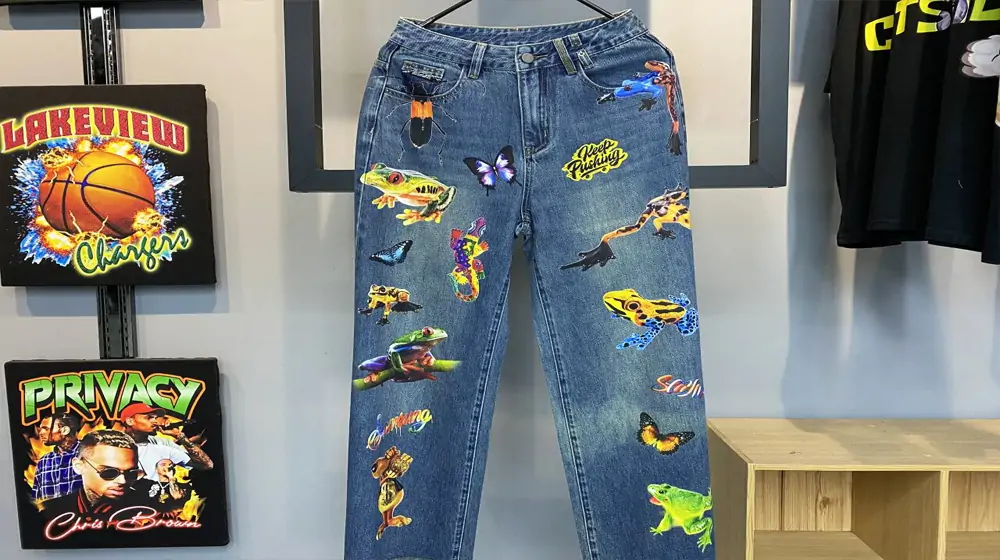
Why White Ink DTG Is the Future of Denim Printing
Denim has always been one of the most challenging materials in garment printing. Its thick texture, complex 3D construction, and strong emphasis on fabric feel make traditional printing methods increasingly limited.
Today, white ink DTG (Direct to Garment) printing is becoming the preferred solution for high-end denim brands and garment manufacturers worldwide.
1. Why Is White Ink DTG Ideal for Denim Printing?
1. Superior Fabric Feel — No Film, No Rubber Touch
Unlike heat transfer or thick plastisol screen printing, DTG printing applies ink directly into the fabric fibers, without any transfer film or adhesive layer.
- Soft hand feel
- Excellent breathability
- No heavy or plastic-like texture
This allows denim garments to maintain their original texture and comfort, which is a key requirement for premium denim brands.
2. Designed for Complex 3D Denim Structures
Denim garments such as jeans and jackets feature complex elements including seams, rivets, pleats, pockets, zippers, and belt loops.
Traditional screen printing and heat transfer often fail in these areas due to uneven pressure and surface height differences.
White ink DTG solves this problem through:
- Non-contact printing
- Intelligent printhead height adjustment
- Precise ink drop control
This enables full-area coverage without missing edges or distortion, even on highly uneven denim surfaces.
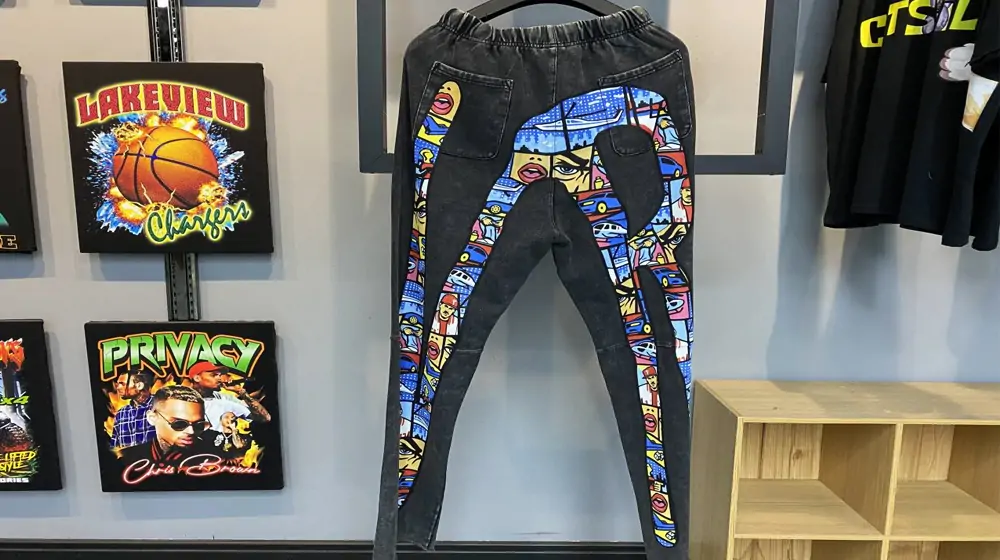
3. Greater Design Freedom with White Ink Control
White ink in DTG printing can be used flexibly as:
- A base layer for vivid colors
- Partial highlights
- Vintage and distressed effects
- Gradients, shadows, and fade-out designs
Designers can achieve high-saturation graphics while preserving the original denim background, unlocking far greater creative possibilities for fashion and streetwear brands.
4. Aligned with Sustainable Fashion Trends
White ink DTG printing features:
- No plate making
- Shorter production workflow
- No transfer film waste
- Minimal wastewater discharge
This makes it a more environmentally responsible solution, fully aligned with global sustainability requirements in the fashion industry.
In one sentence:
If you value authentic denim texture, compatibility with complex garment structures, and fast, flexible production, white ink DTG printing is a more advanced and future-ready solution than screen printing or heat transfer.
2. Solving the Efficiency and Environmental Challenges of Traditional Denim Printing
Traditional denim decoration methods such as washing processes, screen printing, and embroidery often suffer from:
- Long production cycles
- High labor and setup costs
- Limited design capability
- Environmental compliance pressure
How DTG Solves These Problems
- No plate making or color separation
- Complex designs printed in a single pass
- Supports gradients, shadows, and photo-level details
- Significantly reduces delivery time
Environmentally, DTG uses eco-friendly pigment inks with extremely low wastewater output, reducing pollution from washing and cleaning processes.
3. Key Technical Advantages for High Seams and Uneven Denim Surfaces
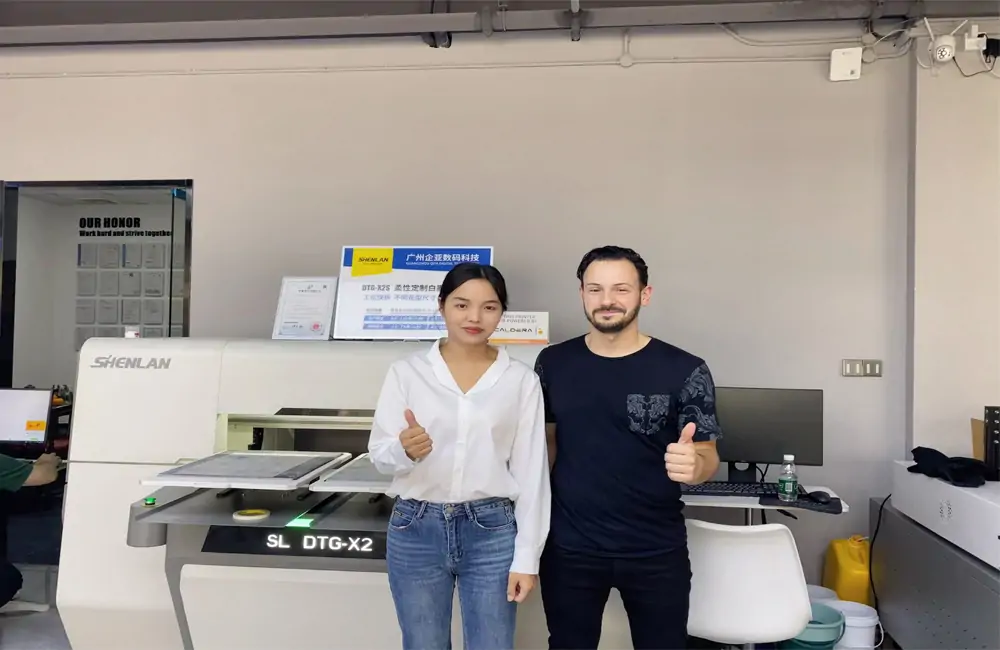
Denim garments often include raised seams and height differences that cause high failure rates in conventional printing.
DTG printers specifically developed for denim address these challenges through three core technologies:
Advantage 1: Non-Contact Printing for Full-Area Coverage
The printhead maintains a stable distance from the fabric while spraying ink precisely at high speed.
Even at raised seams or recessed rivet areas, ink adheres evenly without deformation or missing sections.
Advantage 2: Industrial High-Precision Printheads for Large Height Differences
Standard DTG printers struggle when height differences exceed 3 mm, leading to ink misting or focus loss.
This denim-focused DTG system can adapt to height differences of up to 8 mm, ensuring clean and continuous patterns on complex garment areas such as shoulders and sleeve joints.
Advantage 3: High-Elastic Ink with Precise Curing Control
- Specialized denim inks offer high elasticity and strong adhesion
- Follow-up curing systems (infrared or UV modules) solidify ink evenly
This prevents ink flow, cracking, or halo effects in uneven areas and ensures durability even around zippers and dense seam zones—while maintaining a soft hand feel.
4. White Ink DTG vs Traditional Denim Printing Methods
| Comparison | Screen Printing | White Ink Heat Transfer | White Ink DTG |
|---|---|---|---|
| Plate Making | Required | Not required | Not required |
| Design Freedom | Limited colors | Depends on film | Unlimited colors, flexible white ink |
| Hand Feel | Thick, rubber-like | Film texture | Soft and breathable |
| 3D Structure Adaptation | Poor | Wrinkling risk | Excellent |
| Environmental Impact | High wastewater | Film waste | Minimal waste |
| Customization | Very limited | Low efficiency | One-piece printing |
| Industry Trend | Traditional | Transitional | Digital future |
Conclusion
White ink DTG printing machines are redefining how denim garments are decorated.
They eliminate the limitations of traditional processes while offering unmatched flexibility, design freedom, and sustainability.
For denim brands and garment factories seeking high-value customization, faster turnaround, and future-ready production, DTG is no longer an alternative—it is the direction forward.